Daylight Saving Time kills
Shallow dive in deaths induced by DST
I have been listening to a (fantastic) scientific news report from Sci+, where the first news is about Daylight Saving Time (DST) and its related deaths. Indeed, before that, I have already heard about the significant number of people dying related to the changes in wake-up habits, especially when 'loosing' one hour of sleep, driving while being less awaken than usual.
But is it true?
Getting the data
I did quickly check the French statistics from the official INSEE reports (thankfully available as Open Data), downloaded everything I'm interested in, aggregated the daily values from 1996 (when all of EU setteled on one single day for the changes), up until the end of 2025, and throw some charts.
Really, a few Python scripts, with an optional hint of LLM usage if you feel like it, and you will quickly get results. I will not give any numeric factual deviation from the yearly baseline (or monthly moving average, as there are seasonal changes in death rates), as this is not a scientific report. We want quick and easy facts, don't we?
Does DST kill?
Maybe? Let's see the fall (automn) DST effects:
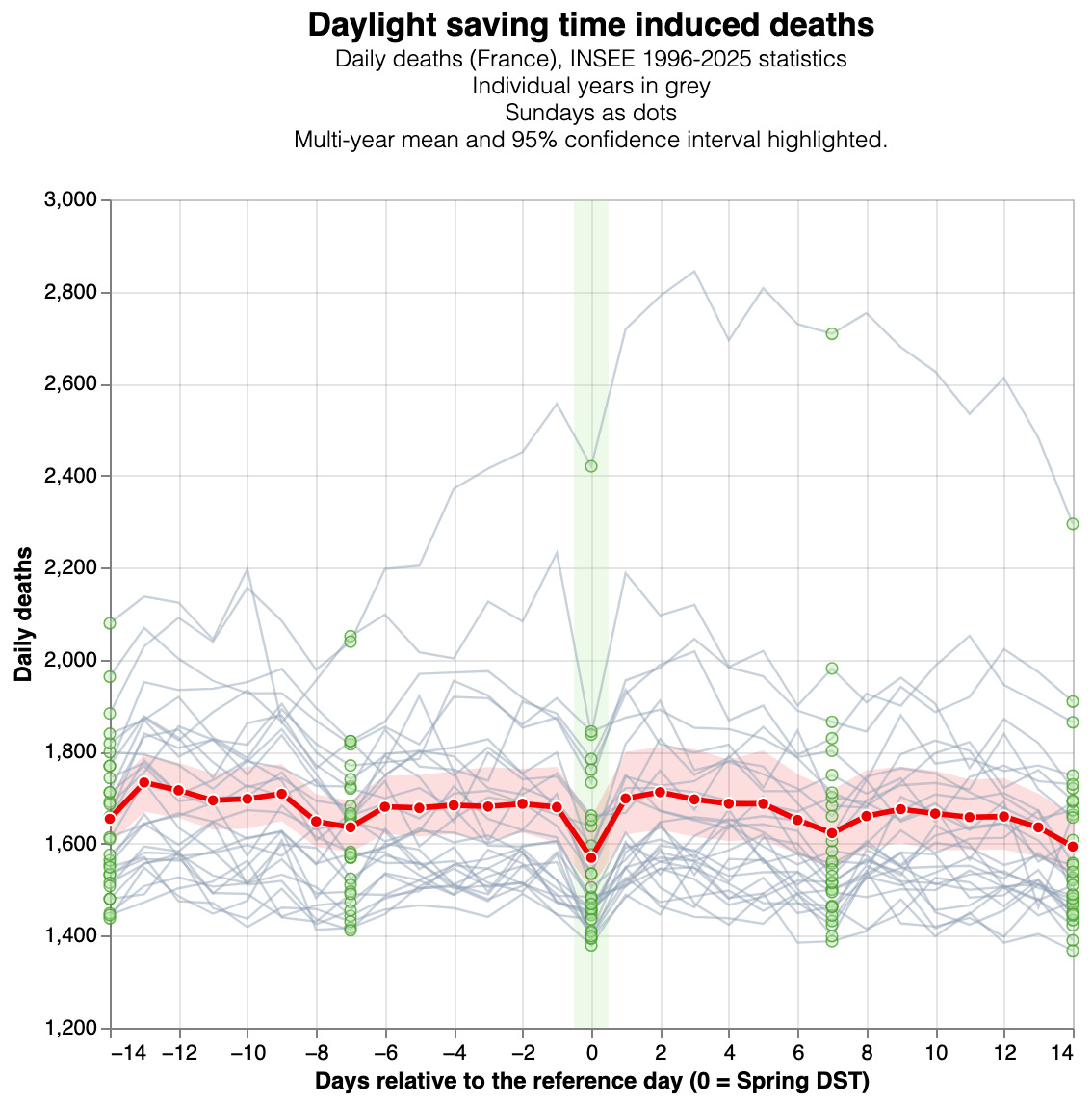
The data is not so clear. However, you can see that I have anticipated a little and highlighted all Sundays. There is a (well-known?) protective effect of Sundays, which I discovered with this study. It's probably God's influence, or maybe that fewer people are on the streets being run-over by cars, or even maybe capitalism kills?! 😱
Refining the analysis, checking for the Sunday effect
Let's go a bit deeper and refine the analysis. Let's compare the death rate, aligning all the January 1st on one side, and alining all the First Monday of the year on the other side. We should be able to see something interesting, if there is any significant effect.
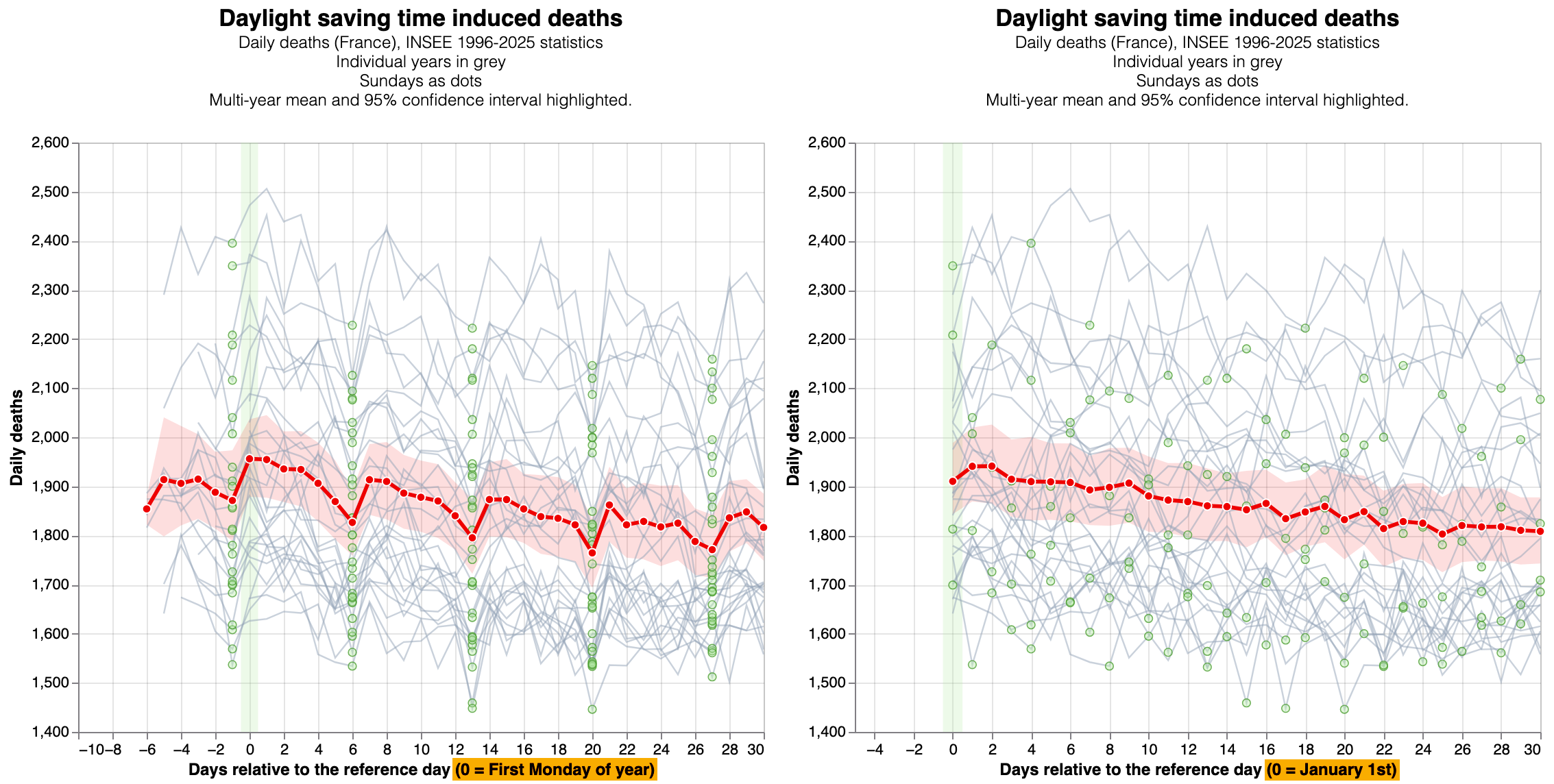
Aha! That's interesting! The highlighting bar is on the 1st Monday of the year, and we clearly see the Sunday dots dipping below the trendline. We also see that people tend to die less at the end of January compared to the beginning of the month.
Selecting Sundays only
Let's filter the data, and keep only Sundays for this analysis (as the daylight changing time only happens on Sundays). I'm widening the range to have more Sundays in the window to better see the effect (if any):
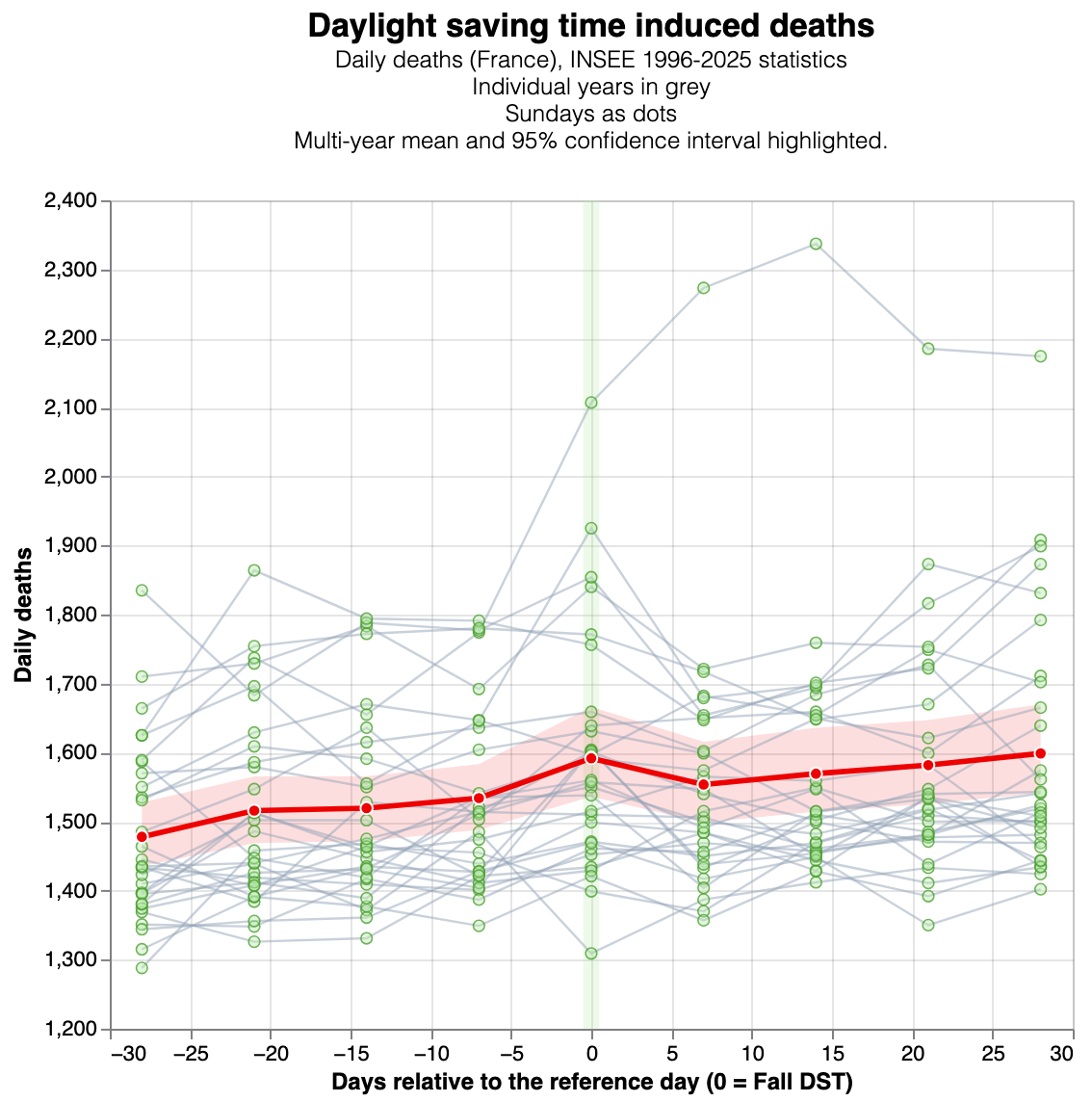
Yay! Clear answer! There is a noticeable rise in deaths when DST happens! (And COVID too, as you can see with the 2020 grey line that tops the chart!)
DST KILLS!
That was quick and easy enough, we can move on now, right?
Wait a minute...
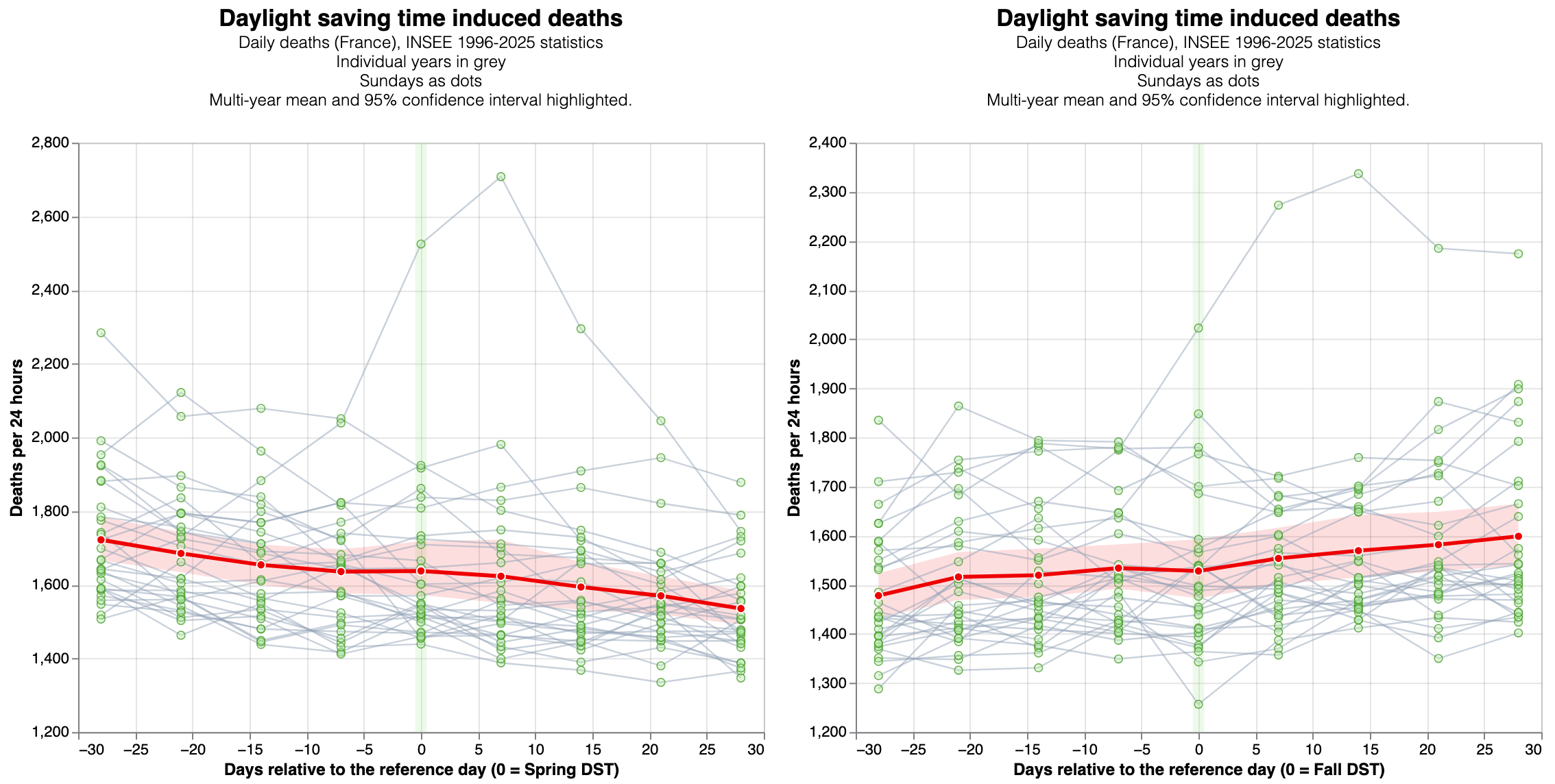
Now we have the data and a way to browse it, let's dig-in a bit further. The previous plot was the automn DST. What about the spring one?
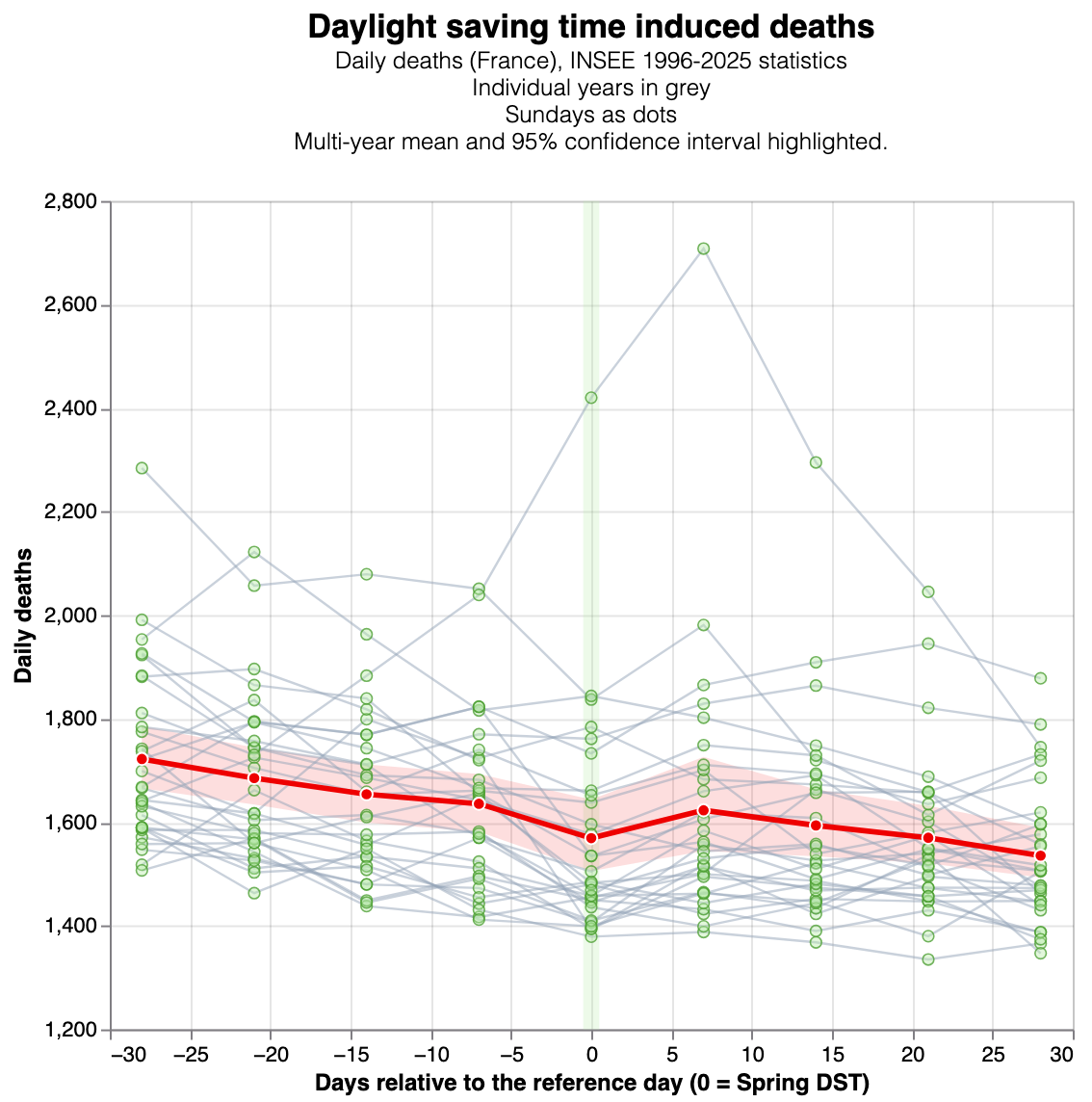
Ah! That's something interesting. The fall DST kills, while the spring DST has a protective effect. This is especially unexpected considering that it's the one that eats up an hour of sleep, leading to worsened rest and half-awoken zombies on the roads.
The more realer truth
Statistics are hard, and there are often multiple effects combining. This is a small article and not a full study. However, you might have found the problem in the plots shown previously. I'll let you think a little, just in case you want to try to find it.
OK, shall we go?
Are you sure?
OK, here is the solution: the Sunday of the spring DST is 23 hours-long, while the fall one is 25 hours long. Basically, it's just some constant-ish probability to die per hour, and when a day is longer or shorter, it shows up in the stats! Let's try to compensate for that, by normalizing the number of death depending on the number of hours in the corresponding day.
Nice! Now, the data does not have a giant 4.2% bias caused by longer or shorter days, and the effect is DST is much much more subtle. It seem to give a little something (and I will not eyeball a p-value), but that needs a much finer analysis.
If you really want to know, the best is to check the litterature review of 157 studies assessing the very question of DST-related deaths. Plot-twist: this is the study mentioned in the video linked at the beginning of this article!
The chart
In case you want to browse with the data and play with the brower I built, here it is: